
Compaction tests · CBR · California bearing ratio
CBR California Bearing Ratio Test
We measure the bearing capacity of road, fill and site soils as a CBR value. We carry out field CBR tests on site with a piston under a reaction load, have laboratory CBR tests carried out in an accredited laboratory, and report the results against your project specification.
Call us directly: +90 533 616 18 67
- Field CBR on site
- Laboratory CBR in an accredited laboratory
- Roads, fill and sites
- Since 2001 soil testing
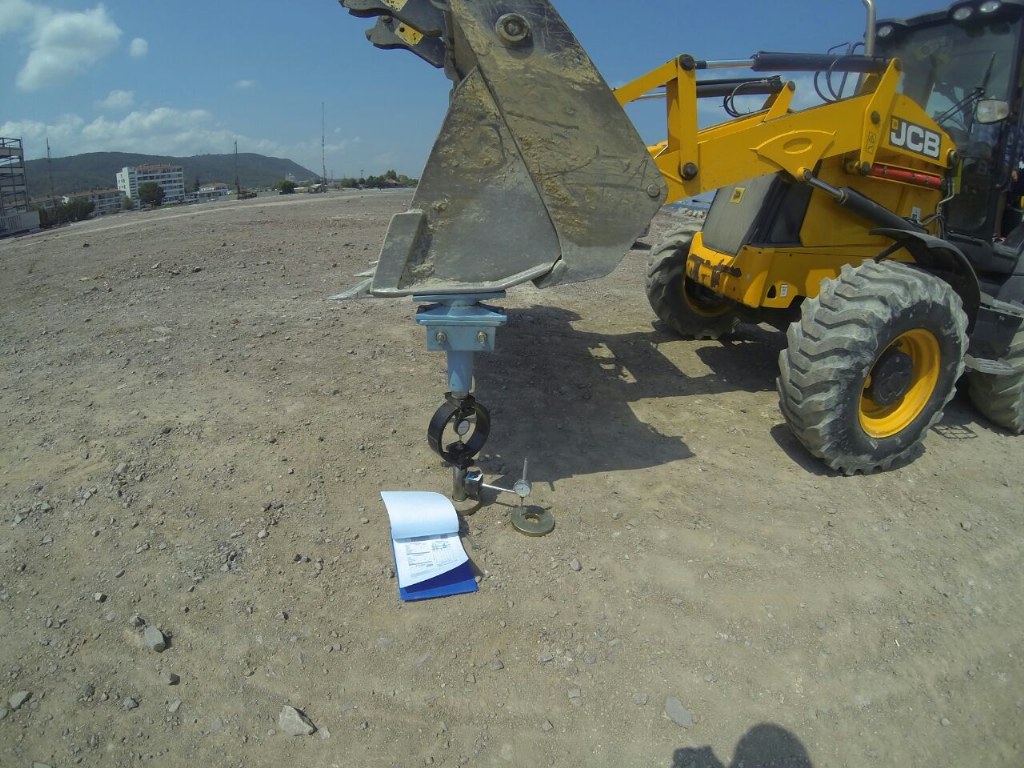
- Reaction load: loaded truck
- Jack and proving ring
- Standard piston, 19.35 cm²
- Surcharge plates
- Dial gauge and reference beam
- Soil being tested
Definition
What is the CBR test?
CBR (California Bearing Ratio) was developed by the California State Highway Department. A cylindrical piston with a cross-section of 19.35 cm² is pushed into the soil at a constant rate and the load needed for a given penetration is measured.
The CBR value is the ratio of this load to the load needed for the same penetration in a standard crushed rock, given as a percentage. The value at 2.5 mm penetration is normally used. If the value at 5 mm is greater, the test is repeated; if the result is the same, the greater value is used.
In the design of road, airport and yard pavements the CBR value shows the bearing capacity of the subgrade. The higher the value, the stronger the soil and the thinner the pavement layers needed. Typical values are about 2% for clay, about 10% for some sands and 80–100% for high-quality sub-base.
At a glance
| Standards | Field CBR: ASTM D4429, BS 1377-9. Laboratory CBR: ASTM D1883, TS EN 13286-47. |
|---|---|
| Piston | 19.35 cm² cross-section, penetration rate about 1.27 mm/min. |
| Standard load | 13.2 kN at 2.5 mm, 20.0 kN at 5 mm. |
| Readings | Load readings in steps up to 12.5 mm penetration. |
| Particle size | Maximum particle size 20 mm. |
| Result | Load–penetration curve, CBR value and moisture content. |
Types of CBR test
Field CBR or laboratory CBR?
Field CBR test
Carried out in place on the soil in its natural or compacted state on site. A loaded truck is used as the reaction load. It shows the actual condition of a completed fill or subgrade.
- Checking compacted fill and subgrade
- Assessing existing road and site soils
- Result read on site the same day
Laboratory CBR test
A sample from site is compacted in a mould at the moisture content from the Proctor test. It is usually soaked for 4 days, swelling is measured, and it is then loaded with the piston. We have these tests carried out in an accredited laboratory.
- Design CBR value for road projects
- Suitability of fill and borrow material
- Soaked value, for the worst condition
On site
How is the field CBR test carried out?
- The surface is preparedLoose material at the test point is removed and the surface is made flat and level.
- The set-up is installedA loaded truck is positioned over the point. The jack, proving ring and piston are placed under the chassis, perpendicular to the ground.
- Surcharge plates are placedSurcharge plates representing the weight of the pavement layers above are placed around the piston.
- The piston is seatedThe piston is seated on the soil with a small load and the dial gauge and load indicator are zeroed.
- PenetrationThe piston is pushed into the soil at a constant rate. Loads are read at set intervals up to 12.5 mm penetration.
- A moisture content sample is takenA sample of about 350 g is taken from just below the test point to determine the moisture content.
- CalculationThe load–penetration curve is plotted and corrected at the start if needed. The loads at 2.5 and 5 mm are divided by the standard loads to give the CBR value.
- ReportingThe load–penetration curve, CBR value, moisture content and compliance with the specification are reported for each point.
Reading the results
How is the CBR value calculated?
The CBR value is calculated separately for two penetrations:
CBR2.5 = P2.5 / 13.2 kN × 100
CBR5 = P5 / 20.0 kN × 100
- Result. The value at 2.5 mm is normally used. If the value at 5 mm is greater, the test is repeated; if the result is the same, the greater value is used.
- Zero correction. A concave part at the start of the curve is caused by the piston seating, and is corrected by shifting the curve to the origin.
Assessment
CBR value calculator
The starting values are an example. The calculator finds the CBR value from the loads at 2.5 and 5 mm, compares it with the specified value and classifies the soil using commonly accepted ranges.
For low-CBR subgrades it also gives an approximate resilient modulus: MR ≈ 10 × CBR (MPa). This approximation is used only for fine-grained soils with low CBR.
This tool is for preliminary assessment. The CBR value used in design is set by the project specification.
Price
CBR test price
The price depends mainly on the number of tests, field or laboratory testing and the project location. It is given per project or as a unit price per test.
- The more tests on the same site, the lower the price per test
- Laboratory CBR needs a Proctor test first
- For field CBR the reaction truck is provided by the site unless agreed otherwise
- The cost is lower when combined with plate load, nuclear and Proctor tests
Fill in the details and your message opens ready to send on WhatsApp. Add a plan showing the test points to the same chat if you have one.
Limits of the method
What should be watched?
- The maximum particle size is 20 mm; results can be misleading in coarse gravelly material. For larger aggregate the plate load test is used
- The field test is not reliable on cohesive soils with high moisture content and a CBR below 5%
- Field CBR reflects the moisture content on the day; the value can fall in wet seasons
- For design, the soaked laboratory CBR value showing the worst condition is preferred
After the test
What is in the report?
- Test points and test details
- Load–penetration curve for each point
- CBR values at 2.5 and 5 mm
- Moisture content, and swelling for laboratory tests
- Comparison with the specified value
From site
From our CBR tests




Comparison
CBR, plate load test or LWD?
| Test | What does it give? | When to choose it? |
|---|---|---|
| CBR | California bearing ratio (%) | Road and yard pavement design, CBR checks required by the specification |
| Plate load test | Bearing capacity, k, Ev1, Ev2 | Ev2 checks on formation and fill |
| Light weight deflectometer (LWD) | Dynamic deformation modulus Evd | Fast checks at many points without a reaction load |
| Proctor | Maximum dry unit weight and optimum moisture content | Reference for compaction control and laboratory CBR |
| Nuclear density | In-situ density and moisture content | Fast check of degree of compaction against Proctor |
Frequently asked questions
About the CBR test
What is the CBR test?
CBR (California Bearing Ratio) is a test in which a piston with a cross-section of 19.35 cm² is pushed into the soil at a constant rate, and the load needed for a given penetration is compared with the load needed for the same penetration in a standard crushed rock. The result is given as a percentage.
How is the CBR value calculated?
The load at 2.5 mm penetration is divided by 13.2 kN and the load at 5 mm by 20.0 kN, and each is multiplied by 100. The value at 2.5 mm is normally used. If the value at 5 mm is greater, the test is repeated; if the result is the same, the greater value is used.
Which standard is the CBR test carried out to?
The field CBR test to ASTM D4429 (BS 1377-9 also describes it), and the laboratory CBR test to ASTM D1883 and TS EN 13286-47. The project specification decides which standard applies.
What is the difference between field CBR and laboratory CBR?
Field CBR is carried out in place on the soil in its natural or compacted state and shows its condition on the day. In laboratory CBR the sample is compacted in a mould at the moisture content from the Proctor test, usually soaked for 4 days, and the value for the worst condition is found.
Do you carry out laboratory CBR tests yourselves?
We take the samples on site. Laboratory CBR and Proctor tests are carried out in an accredited laboratory, and we report the results together with the field tests.
What is a good CBR value?
As a general guide, below 3% is a very poor subgrade, 3–7% poor, 7–20% fair and 20–50% good. Values above 50% are expected for sub-base and base course materials. The exact limits are set by the project specification.
Which materials is the CBR test suitable for?
Soils with a maximum particle size of 20 mm. In coarse gravelly material the result can be misleading and the plate load test is used instead. The field test does not give reliable results on cohesive soils with high moisture content and a CBR below 5%.
What is needed for a field CBR test?
A loaded truck that can reach the test point is needed as a reaction load. Unless agreed otherwise, the truck is provided by the site. The test point must be level and cleared of loose material.
What is the difference between the CBR and the plate load test?
CBR gives the bearing ratio as a percentage with a small piston and is used in pavement design. The plate load test gives bearing capacity, modulus of subgrade reaction and Ev2 with a larger plate. The test carried out is the one whose value the specification requires.
What determines the price of a CBR test?
Mainly the number of tests, field or laboratory testing and the project location. Laboratory CBR also needs a Proctor test. The price is given per project or as a unit price per test.
Let us measure how much your road subgrade can carry
Send us the number of tests, field or laboratory preference, the material and the project location. We will prepare the test programme and send our quote.
Sarıgöl Mah. Mezarlık Sk. C1 No: 108 İç Kapı No: 63
Gaziosmanpaşa, Istanbul, Turkey
Mobile / WhatsApp: +90 533 616 18 67
Phone: +90 212 369 00 16
info@zeminarastirma.com
Mon–Fri 08:00–19:00 · Sat–Sun 08:00–14:00 (GMT+3)